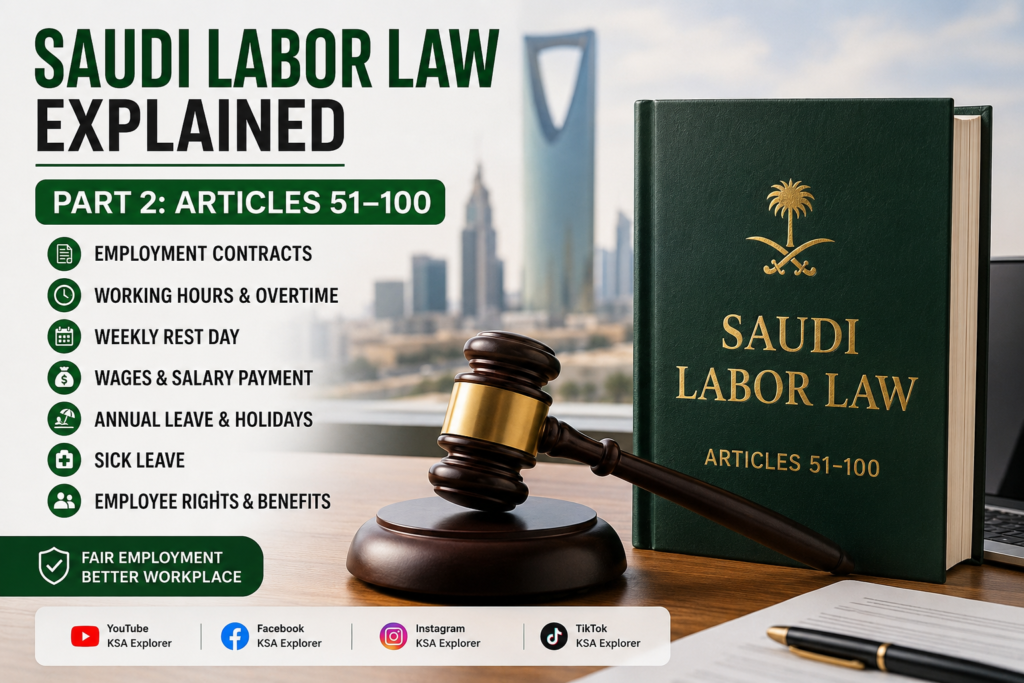
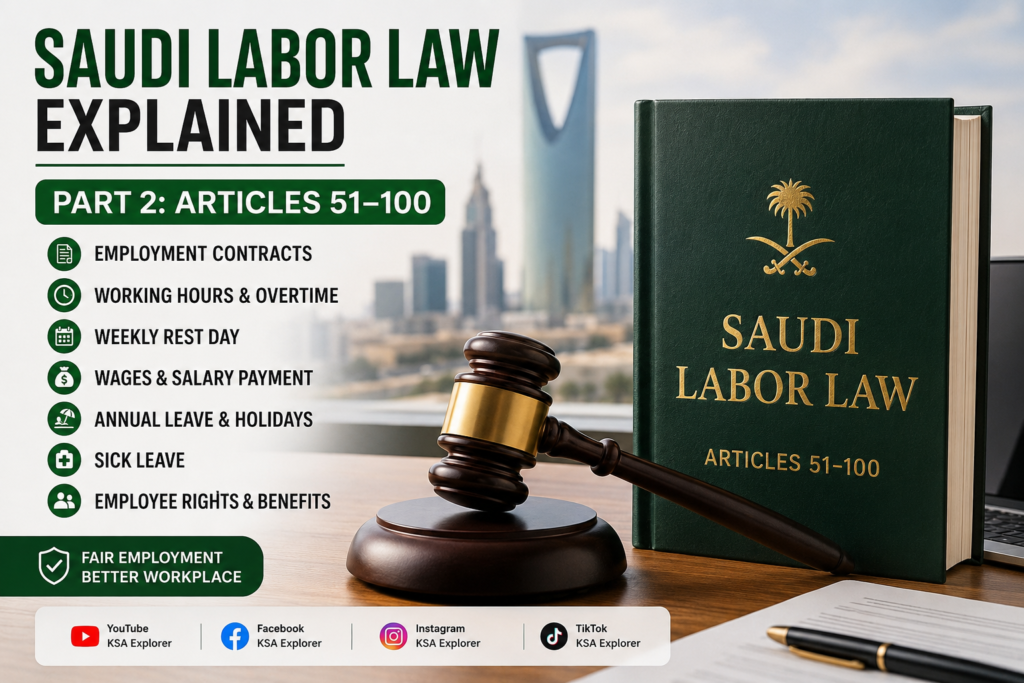
Employment Contracts, Working Hours, Wages & Employee Benefits
Series: Saudi Labor Law Explained (2026)
Part: 2 of 5
Introduction
Articles 51–100 primarily focus on employment contracts, working hours, wages, overtime, weekly rest, annual leave, and employee entitlements. These provisions help establish fair employment practices while balancing the interests of employers and employees.
Contents
- Employment Contracts
- Fixed-Term & Open-Ended Contracts
- Contract Renewal
- Working Hours
- Overtime Rules
- Weekly Rest Day
- Wage Payment
- Salary Deductions
- Annual Leave
- Official Holidays
- Sick Leave
- Articles 51–100 Summary
Employment Contracts (Articles 51–60)
An employment contract defines the legal relationship between an employer and an employee.
A well-written contract should include:
- Employee name
- Employer details
- Job title
- Salary and allowances
- Working hours
- Contract duration
- Leave entitlement
- Place of work
- Probation period (if applicable)
- Termination conditions
Both parties should retain a signed copy of the contract.
Fixed-Term & Open-Ended Contracts
Employment contracts may be:
Fixed-Term
- Valid for a specific period.
- May be renewed by agreement.
- Usually ends on the agreed expiry date unless renewed.
Open-Ended
- Continues until either party legally terminates the employment relationship.
- Common for long-term employment.
Contract Renewal
When a fixed-term contract expires, it may be renewed if both employer and employee agree. Any renewal should clearly specify the updated terms and duration.
Working Hours (Articles 61–70)
Employers should organize work schedules according to applicable labor regulations.
General principles include:
- Reasonable daily working hours
- Weekly working limits
- Required rest breaks
- Safe working conditions
- Compliance with labor regulations
Working hours may differ for certain industries or during specific periods such as Ramadan.
Overtime
Employees who work beyond normal working hours may be entitled to overtime compensation according to applicable labor regulations and the terms of their employment.
Employers should:
- Keep accurate overtime records.
- Pay overtime correctly.
- Avoid excessive working hours that may affect employee health and safety.
Weekly Rest Day
Employees are generally entitled to a regular weekly rest day.
This allows workers to:
- Recover physically.
- Spend time with family.
- Maintain a healthy work-life balance.
Wage Payment (Articles 71–80)
Employers should:
- Pay salaries on time.
- Follow the agreed payment schedule.
- Maintain payroll records.
- Provide transparency regarding salary payments.
Late or improper payment of wages may result in legal consequences.
Salary Deductions
Employers should not make unauthorized deductions from employee wages.
Any deductions should:
- Be legally permitted.
- Be clearly documented.
- Comply with applicable labor regulations.
Annual Leave
Employees may become entitled to paid annual leave based on applicable labor regulations and their length of service.
Annual leave helps employees:
- Rest and recover.
- Maintain productivity.
- Improve overall well-being.
Public Holidays
Employees are generally entitled to official public holidays announced by the Kingdom, subject to applicable labor regulations and workplace requirements.
Sick Leave (Articles 81–90)
Employees who become ill may be eligible for sick leave in accordance with labor regulations.
Medical documentation may be required where applicable.
Employee Responsibilities
Employees should:
- Perform assigned duties professionally.
- Follow workplace policies.
- Respect company property.
- Observe health and safety rules.
- Maintain confidentiality where required.
Employer Responsibilities
Employers should:
- Respect employment contracts.
- Provide a safe workplace.
- Pay salaries on time.
- Treat employees fairly.
- Comply with Saudi labor regulations.
Articles 91–100 Overview
This section generally covers additional employment rights and responsibilities, including workplace obligations, wage-related matters, and compliance requirements designed to support fair employment practices.
Key Takeaways
- Employment contracts should clearly define all terms and conditions.
- Employees should receive wages according to the agreed schedule.
- Working hours and overtime should comply with labor regulations.
- Employees are generally entitled to weekly rest and annual leave.
- Employers should maintain transparent payroll and employment records.
- Both employers and employees share responsibility for maintaining a safe and professional workplace.
Disclaimer
This guide is an educational summary written in plain English for informational purposes only. It does not replace the official Saudi Labor Law or professional legal advice. Readers should consult the latest official legislation and the relevant Saudi authorities for legally binding requirements.
Next: Part 3 – Articles 101–150, covering leave entitlements, occupational safety, workplace health, training, and additional employee protections.