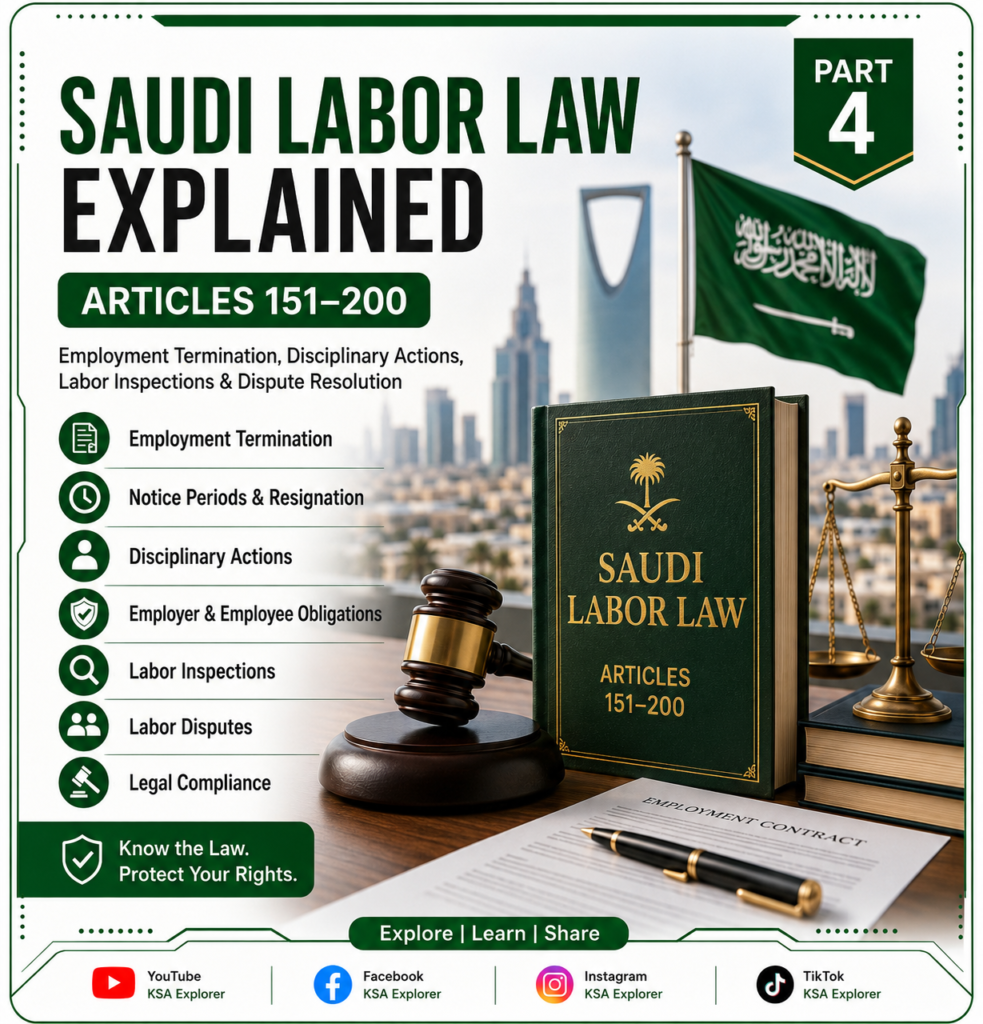
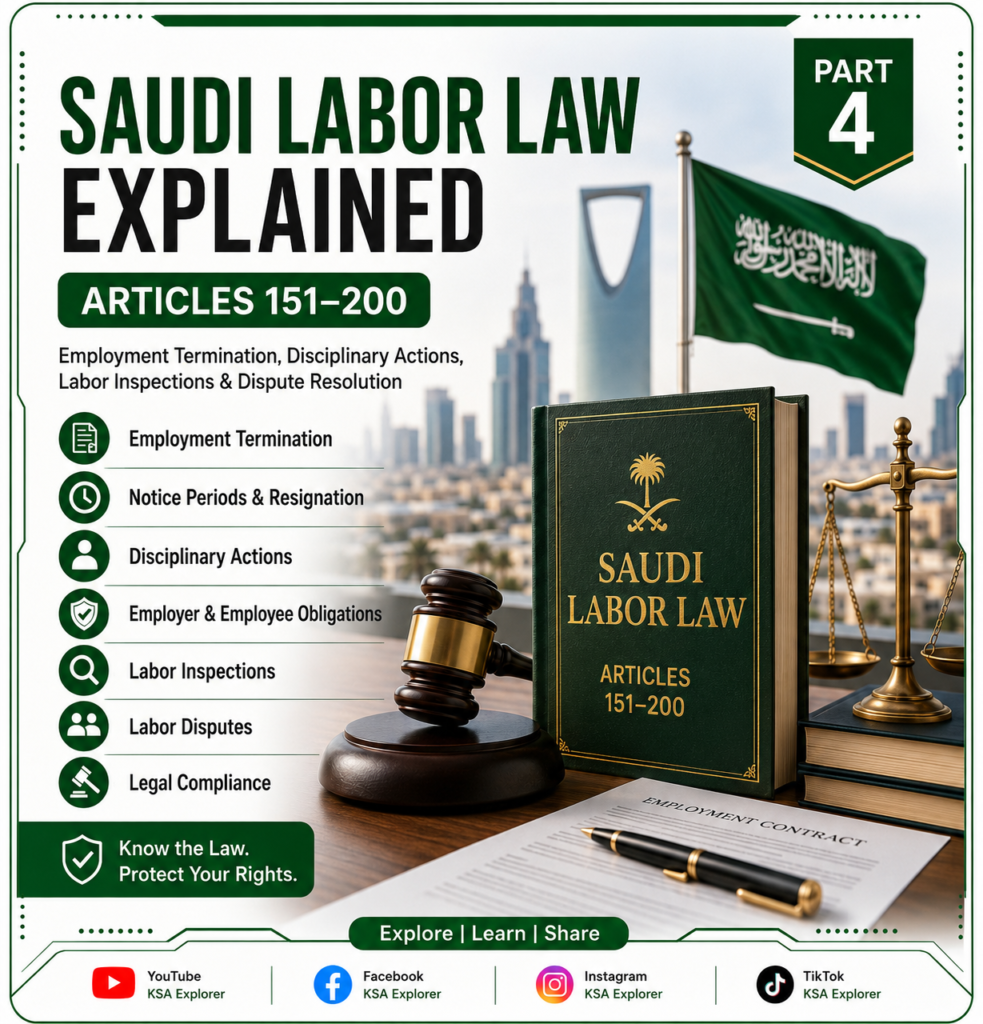
Employment Termination, Disciplinary Actions, Labor Inspections & Dispute Resolution
Series: Saudi Labor Law Explained (2026)
Part: 4 of 5
Introduction
Articles 151–200 generally focus on employment termination, disciplinary procedures, labor inspections, dispute resolution, employer compliance, and legal responsibilities. These provisions are designed to ensure fairness, accountability, and compliance in Saudi Arabia’s private-sector workplaces.
Table of Contents
- Employment Termination
- Notice Periods
- Resignation
- Disciplinary Actions
- Employer Obligations
- Employee Responsibilities
- Labor Inspections
- Labor Disputes
- Legal Compliance
- Articles 151–200 Explained
- Key Takeaways
Employment Termination
Employment may end for various lawful reasons, including:
- Expiry of a fixed-term contract
- Mutual agreement
- Resignation
- Retirement
- Lawful dismissal
- Other legally recognized circumstances
Termination should always follow the applicable labor regulations and the employment contract.
Notice Periods
Where applicable, employers and employees should provide the required notice before ending an employment relationship.
Proper notice allows both parties to prepare for the transition and helps avoid unnecessary disputes.
Resignation
Employees may resign by following the procedures specified in their employment contract and applicable labor regulations.
Before resigning, employees should:
- Submit a written resignation.
- Observe the required notice period (where applicable).
- Complete the handover of company property and responsibilities.
Disciplinary Actions
Employers may take disciplinary action when workplace rules are violated.
Examples may include:
- Written warnings
- Temporary disciplinary measures
- Other lawful actions consistent with company policies and labor regulations
Any disciplinary process should be fair, documented, and proportionate.
Employer Responsibilities
Employers should:
- Apply workplace rules fairly.
- Maintain accurate employment records.
- Respect employee rights.
- Follow legal procedures before taking disciplinary action.
- Cooperate with labor authorities when required.
Employee Responsibilities
Employees should:
- Follow workplace policies.
- Perform assigned duties responsibly.
- Respect supervisors and colleagues.
- Protect company property.
- Maintain professional conduct.
Labor Inspections
Labor authorities may conduct inspections to verify compliance with labor regulations.
Inspections may review:
- Employment contracts
- Wage records
- Working hours
- Occupational safety measures
- Employee documentation
- General workplace compliance
Employers should cooperate fully during inspections.
Labor Disputes
If disagreements arise between employers and employees, they should first attempt to resolve the matter through communication.
If no agreement is reached, disputes may be referred to the appropriate labor authorities or judicial bodies in accordance with Saudi labor regulations.
Legal Compliance
Both employers and employees are expected to comply with:
- Saudi Labor Law
- Employment contracts
- Workplace regulations
- Health and safety standards
- Government labor requirements
Compliance helps create a stable and productive working environment.
Articles 151–160 Explained
These articles generally address employment termination procedures and the legal responsibilities of both employers and employees when an employment relationship ends.
Articles 161–170 Explained
This section focuses on disciplinary measures, workplace conduct, and fair administrative procedures.
Articles 171–180 Explained
These provisions generally relate to labor inspections, employer compliance, and maintaining proper employment records.
Articles 181–190 Explained
This section covers labor disputes, legal procedures, and mechanisms available for resolving employment-related disagreements.
Articles 191–200 Explained
These articles generally emphasize legal compliance, enforcement, and the responsibilities of employers and employees in maintaining lawful workplace practices.
Key Takeaways
- Employment termination should follow legal procedures.
- Both employers and employees should respect contractual obligations.
- Disciplinary actions must be fair and properly documented.
- Labor inspections help ensure compliance with Saudi labor regulations.
- Labor disputes should be resolved through appropriate legal channels.
- Compliance with labor laws benefits both businesses and employees.
Disclaimer
This guide is an original educational summary written in simple English. It is intended for informational purposes only and does not replace the official Saudi Labor Law or professional legal advice. For legally binding information, always refer to the latest official Saudi labor regulations.