Question:
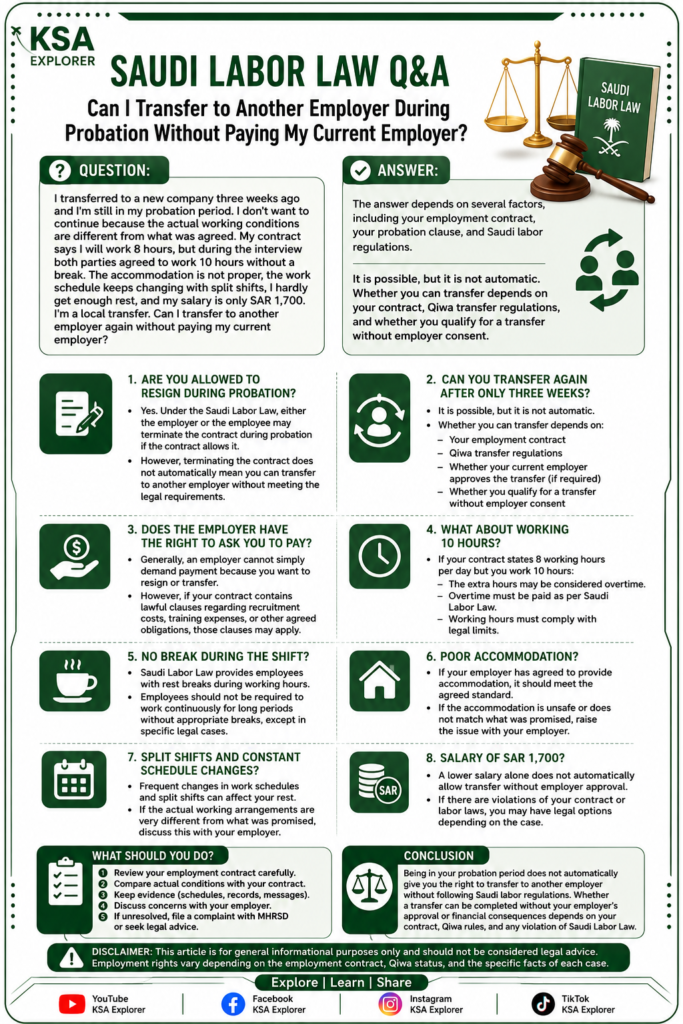
I transferred to a new company three weeks ago and I’m still in my probation period. I don’t want to continue because the actual working conditions are different from what was agreed. My contract says I will work 8 hours, but during the interview both parties agreed to work 10 hours without a break. The accommodation is not proper, the work schedule keeps changing with split shifts, I hardly get enough rest, and my salary is only SAR 1,700. I’m a local transfer. Can I transfer to another employer again without paying my current employer?
Answer
The answer depends on several factors, including your employment contract, your probation clause, and Saudi labor regulations.
1. Are You Allowed to Resign During Probation?
Yes.
Under the Saudi Labor Law, if your employment contract includes a probation period, either the employer or the employee may terminate the contract during probation if the contract allows it or if the applicable legal conditions are met.
However, terminating the contract does not automatically mean you can immediately transfer to another employer without meeting the legal transfer requirements.
2. Can You Transfer Again After Only Three Weeks?
It is possible, but it is not automatic.
Whether you can transfer depends on:
- Your employment contract.
- Qiwa transfer regulations.
- Whether your current employer approves the transfer (if required).
- Whether you qualify for one of the situations that allow a transfer without employer consent.
Each case is assessed according to the applicable Saudi labor and employment regulations.
3. Does the Employer Have the Right to Ask You to Pay?
Generally, an employer cannot simply demand payment because you want to resign or transfer.
However, if your contract contains lawful clauses regarding recruitment costs, training expenses, or other agreed obligations, those clauses may need to be reviewed individually.
Always check your signed employment contract before making any decision.
4. What About Working 10 Hours?
If your employment contract clearly states 8 working hours per day, but you are regularly required to work 10 hours, you should clarify:
- Whether the additional hours are considered overtime.
- Whether overtime is being paid according to Saudi Labor Law.
- Whether the schedule complies with legal working hour limits.
Employees should receive overtime compensation whenever applicable under the law.
5. No Break During the Shift
Saudi Labor Law generally provides employees with rest breaks during working hours. Employees should not be required to work continuously for long periods without appropriate breaks, except where legally permitted under specific regulations.
If you are consistently working long hours without any break, you should first discuss the issue with your employer.
6. Poor Accommodation
If your employer has agreed to provide accommodation, it should meet the agreed standard and any applicable legal or contractual requirements.
If the accommodation is unsafe or does not match what was promised, you should document the issue and raise it with your employer.
7. Split Shifts and Constant Schedule Changes
Frequent changes in work schedules and split shifts can significantly affect an employee’s rest and work-life balance.
If the actual working arrangements are substantially different from what you accepted when signing the contract, you should discuss the matter with your employer and request clarification.
8. Salary of SAR 1,700
Receiving a lower salary alone does not automatically entitle an employee to transfer without employer approval.
However, if there are violations of the employment contract or labor regulations, the employee may have legal options depending on the specific circumstances.
What Should You Do?
If you are facing these issues:
- Review your employment contract carefully.
- Compare your actual working conditions with the contract.
- Keep evidence of schedules, attendance records, and any communication.
- Discuss the concerns with your employer.
- If the issues remain unresolved, you may submit a complaint through the Ministry of Human Resources and Social Development (MHRSD) or seek legal advice before taking further action.
Conclusion
Being in your probation period does not automatically give you the right to transfer to another employer without following Saudi labor regulations. Whether a transfer can be completed without your employer’s approval or without any financial consequences depends on your specific contract, the applicable Qiwa transfer rules, and whether there has been a violation of Saudi Labor Law.
If your employer is requiring working conditions that differ from your signed contract—such as longer working hours without overtime, lack of proper breaks, or other contractual violations—you should first document these issues and seek guidance through the appropriate legal channels.
Disclaimer: This article is for general informational purposes only and should not be considered legal advice. Employment rights vary depending on the employment contract, Qiwa status, and the specific facts of each case.