
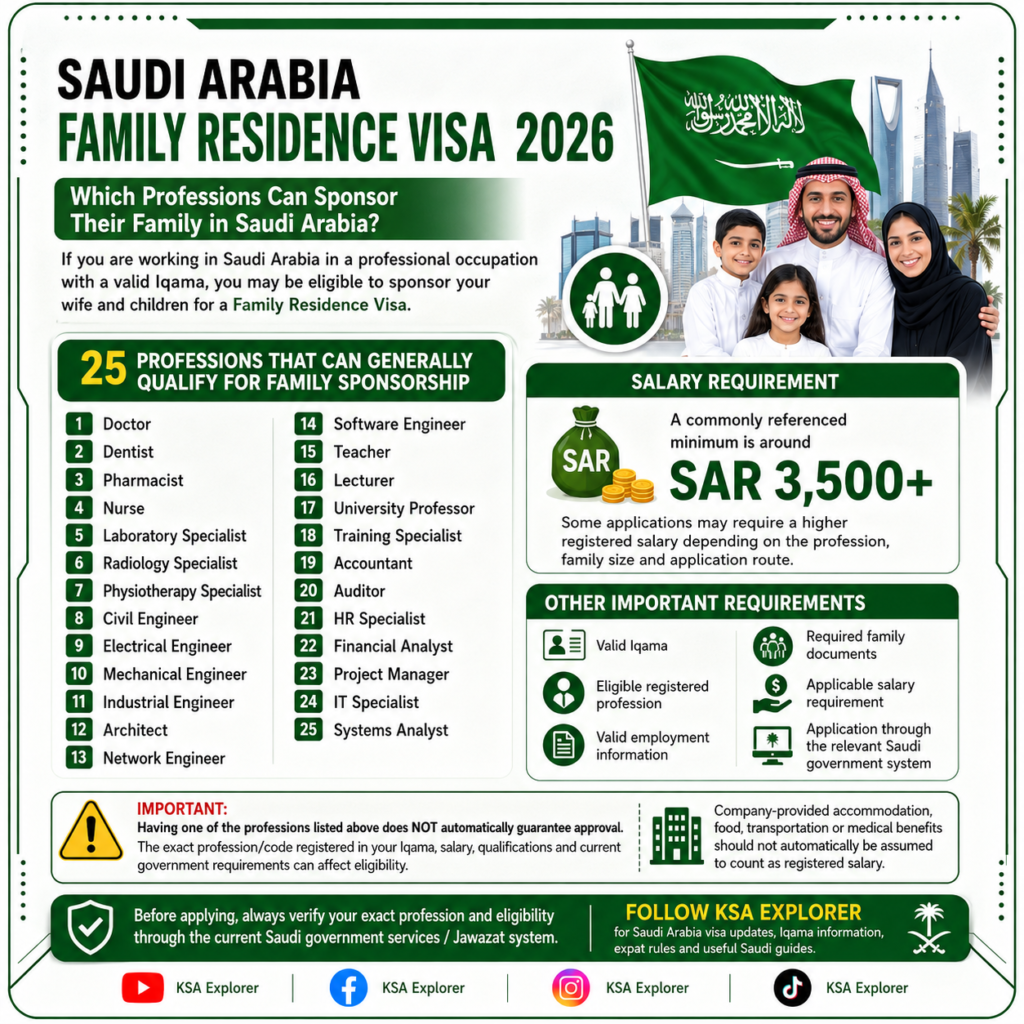
Can an expatriate working in Saudi Arabia bring his wife and children to live with him? Which professions are eligible? How much salary is required? And what documents are needed?
These are some of the most common questions asked by expatriates living and working in Saudi Arabia.
In general, eligible residents can sponsor eligible family members for residence in Saudi Arabia, subject to the applicable immigration, profession, salary and documentation requirements. The Saudi government’s Absher platform provides an electronic service for issuing a Residence ID (Iqama) for family members. (Absher)
Is There a Fixed Minimum Salary?
One of the biggest misconceptions about Saudi family sponsorship is that there is one officially published salary figure that applies to every expatriate.
There is currently no single public salary table that universally applies to every nationality, profession and family size.
Current guidance commonly discusses salaries in the region of SAR 4,000–6,000+ per month, depending on the applicant’s profession, registered salary, family circumstances and application route. Therefore, expatriates should not assume that earning exactly SAR 3,500 automatically guarantees family sponsorship. (GulfVisaHub)
Practical Salary Guidance
As a general planning figure:
- SAR 3,500: May be quoted in some unofficial guidance, but should not be treated as a guaranteed government threshold.
- SAR 4,000+: A more realistic level to investigate eligibility.
- SAR 5,000+: Provides a stronger position in many commonly reported cases.
- SAR 6,000+: May be more practical for applicants supporting a larger family.
The most important point is that the salary registered in the official employment records should be checked. Company-provided accommodation, food, transportation or medical benefits should not automatically be treated as part of the registered salary.
Which Professions Can Generally Qualify?
Profession is another important factor. The occupation registered in the expatriate’s official records matters more than the informal job title used at the workplace.
Below are 25 professional occupations commonly associated with family sponsorship eligibility:
- Doctor
- Dentist
- Pharmacist
- Nurse
- Laboratory Specialist
- Radiology Specialist
- Physiotherapy Specialist
- Civil Engineer
- Electrical Engineer
- Mechanical Engineer
- Industrial Engineer
- Architect
- Network Engineer
- Software Engineer
- Teacher
- Lecturer
- University Professor
- Training Specialist
- Accountant
- Auditor
- HR Specialist
- Financial Analyst
- Project Manager
- IT Specialist
- Systems Analyst
Important: This should not be interpreted as an official exhaustive list of 25 guaranteed professions. Eligibility can depend on the exact occupation/code registered in the Saudi system and the current rules applicable to the applicant.
For example, an expatriate working in a company as a Maintenance Technician or Electrical Technician should check the exact profession registered on the Iqama and employment records rather than relying only on the job title used inside the company.
What About Technicians and Skilled Workers?
This is an important point for many expatriates.
A person may actually perform technical or maintenance work but have a different profession registered in the Saudi system. Therefore, before applying for family sponsorship, check the exact profession appearing in your official records.
Do not assume that a job title such as “Technician” automatically has the same eligibility as an engineering or specialist profession.
Main Requirements for Family Residence
Applicants should normally prepare the following:
1. Valid Iqama
The sponsor should have a valid Saudi Residence ID (Iqama).
2. Eligible Profession
The sponsor’s registered occupation must meet the applicable requirements.
3. Registered Employment and Salary
The employment information and registered salary should be accurate and up to date.
4. Valid Passports
The sponsor and family members should have valid passports.
5. Marriage Certificate
For a spouse, the marriage certificate may need to be properly authenticated/attested according to the applicable procedure.
6. Children’s Birth Certificates
Birth certificates or other required documents may be needed for children.
7. Medical Examination
Where required, family members entering Saudi Arabia for residence must complete the applicable medical examination through an approved medical centre. Absher’s official guidance states that a family member must pass the required medical check for Iqama issuance. (Absher)
8. Health Insurance
Health insurance requirements apply to residents and their eligible family members. Absher’s official guidance also lists medical insurance for the worker and accompanying family members among the relevant requirements. (Absher)
How to Apply for Family Residence
The exact application route can depend on the applicant’s circumstances and the current government process. Generally, the process involves the following stages:
Step 1 — Check Your Profession
First, verify the exact profession registered against your Iqama and employment record.
Step 2 — Check Your Salary
Check the salary officially recorded for you rather than calculating your entire employment package.
Step 3 — Prepare Family Documents
Prepare passports, marriage certificate, children’s birth certificates and other required documents.
Step 4 — Submit the Family Residence Application
Use the applicable Saudi government visa/recruitment channel for the family residence application and complete the required information.
The Saudi Ministry of Foreign Affairs visa platform provides services for residents and includes visa-related services for family members. (Visa Services)
Step 5 — Complete Visa and Medical Procedures
After approval, family members complete the required procedures outside Saudi Arabia, including the applicable medical examination and visa processing.
Step 6 — Family Enters Saudi Arabia
After the residence visa is issued, the family members can enter Saudi Arabia according to the visa validity and conditions.
Step 7 — Issue the Family Iqama
Once the family member is inside Saudi Arabia and the applicable requirements have been completed, the sponsor can use the Absher service for issuance of the family member’s Residence ID.
Absher specifically provides an Issuance of Iqama for Family Members service. The official guide lists requirements including an entry number, medical examination, valid passport, fingerprints/photo registration and payment of the applicable fees. (Absher)
How Much Does Family Iqama Cost?
According to the current Absher service information, the listed issuance fee for a resident family member is SAR 500 for the applicable Residence ID issuance service. Other government charges, dependent fees, insurance and visa-related costs can apply separately depending on the circumstances. (Absher)
Therefore, applicants should not calculate the entire family sponsorship cost based only on the Iqama issuance fee.
Family Visit Visa vs Family Residence Visa
These two options should not be confused.
Family Visit Visa
A family visit visa is intended for visiting relatives for a temporary period and does not provide the same long-term residence status as a dependent Iqama.
Family Residence Visa
A family residence visa allows eligible family members to live in Saudi Arabia under the sponsor’s residency, subject to the applicable rules and requirements. After entry and completion of the required procedures, a family member’s Residence ID can be issued through the relevant Saudi system. (Absher)
Important Advice for Expatriates
Before paying an agent or submitting an application, check these four things:
1. Your exact registered profession
2. Your officially registered salary
3. Your Iqama and employment status
4. The current government requirements at the time of application
Do not rely on social-media posts claiming that “SAR 3,500 is guaranteed” or that a particular profession automatically guarantees family sponsorship.
Saudi immigration procedures and electronic services can change, and approval ultimately depends on the applicable government rules and the applicant’s individual circumstances.
Final Takeaway
For expatriates who want to live permanently in Saudi Arabia with their wife and children, profession and registered salary are important factors, but there is no single salary figure that should be treated as a universal guarantee for every applicant.
Professional occupations such as doctors, engineers, accountants, IT professionals, teachers and other specialist roles are commonly associated with family sponsorship, but applicants should always verify their exact registered occupation/code.
If your goal is to bring your family to Saudi Arabia, the safest approach is to verify your profession, salary, documents and eligibility through the current official Saudi government systems before beginning the application.
Follow KSA Explorer for Saudi Arabia visa updates, Iqama information, expatriate rules, family visa news and practical Saudi guides.